Quick Typewriter Overview.
You caught a glimpse of one in a vision. You woke up sweating. Suddenly, a new desire has been awakened in you.
You need a writing machine.
I’ve spent twenty decades fumbling with a lot of typewriters. I’ve wasted time and money learning to discern what works best for writing; trying to balance visual appeal with practicality.
Some machines will lure you in with their looks, and leave you dry just when that masterpiece is on the tip of your tongue (or, in this case, your fingers).
For instance, the old machines from the 20's and 30's, with those iconic ‘glass keys’ (they’re actually a sort of plastic) are gorgeous. I started there. I bought probably 10 of those, back when they costed a pittance.
Many of them sort of worked, and each had its little idiosyncrasy, which basically rendered it useless for what I wanted to do. (write scripts and novels).
A Smith Corona Silent I found during this time stayed with me, and it gradually became my favorite. I've written 3 novels on this machine, and a few non-fiction books and countless outlines, notes, songs, scraps.
While it is still more bare-bones than some more contemporary models, it already incorporates a basket shift, which really makes it a pleasure to type on, at almost any speed. Still, because of its age, there are a few minor issues that more modern designs have remedied.
Occasionally, a letter or a space will skip as I break into a gallop. And that is only when I’m going REALLY FAST. Most typers would never get there, unless you’re doing 5 hours a day for years or you were a typist in a past life, get me? Also, I sort barely maintain my own writing machine, and expect it to perform miracles, which it generally does.
Jump forward a few decades to more modern machines, like an Olympia SM9, a Hermes 3000, or an iconic Olivetti (Lettera 32, 21, Studio 44), and the engineering gets tighter and some problems are remedied. (Though in my experience, every machine has its Achilles heel).
Some of the machines, while eminently practical, lack something of the sensuality I crave. Something ineffable. Something perhaps older I wanted; a different feel, smell, weight.
People want different machines for different reasons. Follow your heart and mind, and not one at the expense of the other.
A machine has to be practical. It is, in the end, a writing tool.
But to be inspiring, it also needs to possess some of the quintessential design elements of a vintage manual typewriter.
If you actually want to write on it, you need more than just a glass-keyed, well-engineered doorstop.
So, while I appreciate the beauty of older machines, the machines I’ve gathered here balance the aesthetic with the usability. A lot of considerations have gone into me choosing these particular machines for your writing pleasure. Sometimes, the rubber components like platens or the rubber feet on certain machines wear out, and some of these parts cannot be replaced. Sometimes, a machine is just too clunky to really rival its smaller brethren (an Olivetti Studio 44, for instance), so I don’t really recommend it.
What you want is something beautiful and inspiring that will also write thousands or hundreds of thousands or even millions of words for you over the years, even after some abuse. Something reliable that can become a true companion in your writing life.
There are some features that we may have become accustomed to in your digital typing career that you’ve taken for granted. For instance, vintage typewriters often don’t have a 1 key… one is meant to use the lower case L as a 1. Similarly, the upper-case O often stands in for the 0, which doesn’t exist on some keyboards. Most of the typewriters I’m referring to here do have options for single, double, or sometimes triple or half-line spacing. With a duo-tone ribbon, some machines have the ability to switch between red and black at the flick of a switch. You can also use this with a fully black ribbon if you use up one half, and want to switch to the other half.
Ribbons, by the way, can be found everywhere. They usually come on cheap plastic spools, and I like to wind them onto the original metal spools that often come with the typewriter, because it just feels more sturdy and is more true to the spirit of the time.
Some typewriters, like Olivetti the Lettera 22 / 32, have little threaded caps that hold the ribbon into place (though a few are spring held). Without these idiosyncratic pieces, the typewriter can’t be used, which is something of a design flaw in my opinion, in a world where most ribbons just sit in place and you’re good to go.


Welcome to one of history’s finest typewriters, lovingly restored for your writing pleasure.
Order now. In about 2 weeks, you’ll get a stunning, authentic, lovingly-restored specimen of this model in the condition selected.
***
The iconic typewriter design has been used be legends too numerous to name. Great alignment and type action. Light touch needed, in contrast to many vintage machines. Almost feels like an electric machine.
These come in 12 character per inch elite font or 10 Character per inch ‘Pica’.
The Lettera 32 only comes in blue. There are versions made in Spain, UK, England, and Canada. They are all identical with only slight variations. [We don’t sell the Mexican ones, and all the ones we sell are QWERTY keyboards]
The case is a simple zipper affair. Often the zipper is broken. Sometimes, we replace with another contemporary case. Sometimes, the case needs to be secured shut with something. These are not great cases.
This comes with the original metal spools for the ribbon, which works better. A fresh ribbon has been installed, 2 tone black and red. Resurfaced platen.
When these are working well, they are so fluid and functional, with an aesthetic charm that few machines match.
The cases on these are the weak link: the zipper is usually broken, though they still offer some protection.
***
There are a few points in history where form meets function so deliberately that a work of art is born in the union.
The Lettera 22 was designed by Marcello Nizzoli in 1950, and was an immediate sensation. It was awarded the Compasso d'oro prize in 1954. In 1959 the Illinois Institute of Technology chose the Lettera 22 as the best design product of the last 100 years. A specimen can be found in the Museum of Modern Art in New York City.
Marcello Nizzoli followed up the wildly successful Lettera 22 design with the Lettera 32 thirteen years later. Though things got a little more square and less organic, something beautiful happened; one of history’s iconic typewriters was born. It’s been the machine chosen by countless writers throughout the century, including some of the most iconic creators of our times; Thomas Pynchon, Bob Dylan, Leonard Cohen.
Classictypewriter.com
***
****
We restore beautiful machines and put them in the hands of writers, poets, and dreamers.
When the inspiration strikes, be ready!™
If you have questions please don’t hesitate to ask! I want you writing, Screenless!
Most sincerely,
Steven Budden Jr.
Classic Typewriter Co.
Chapel Hill, North Carolina
RESOURCES
WHAT SETS US APART
Our Promise | Warranty | Working Guarantee | Lifetime Tradein Policy
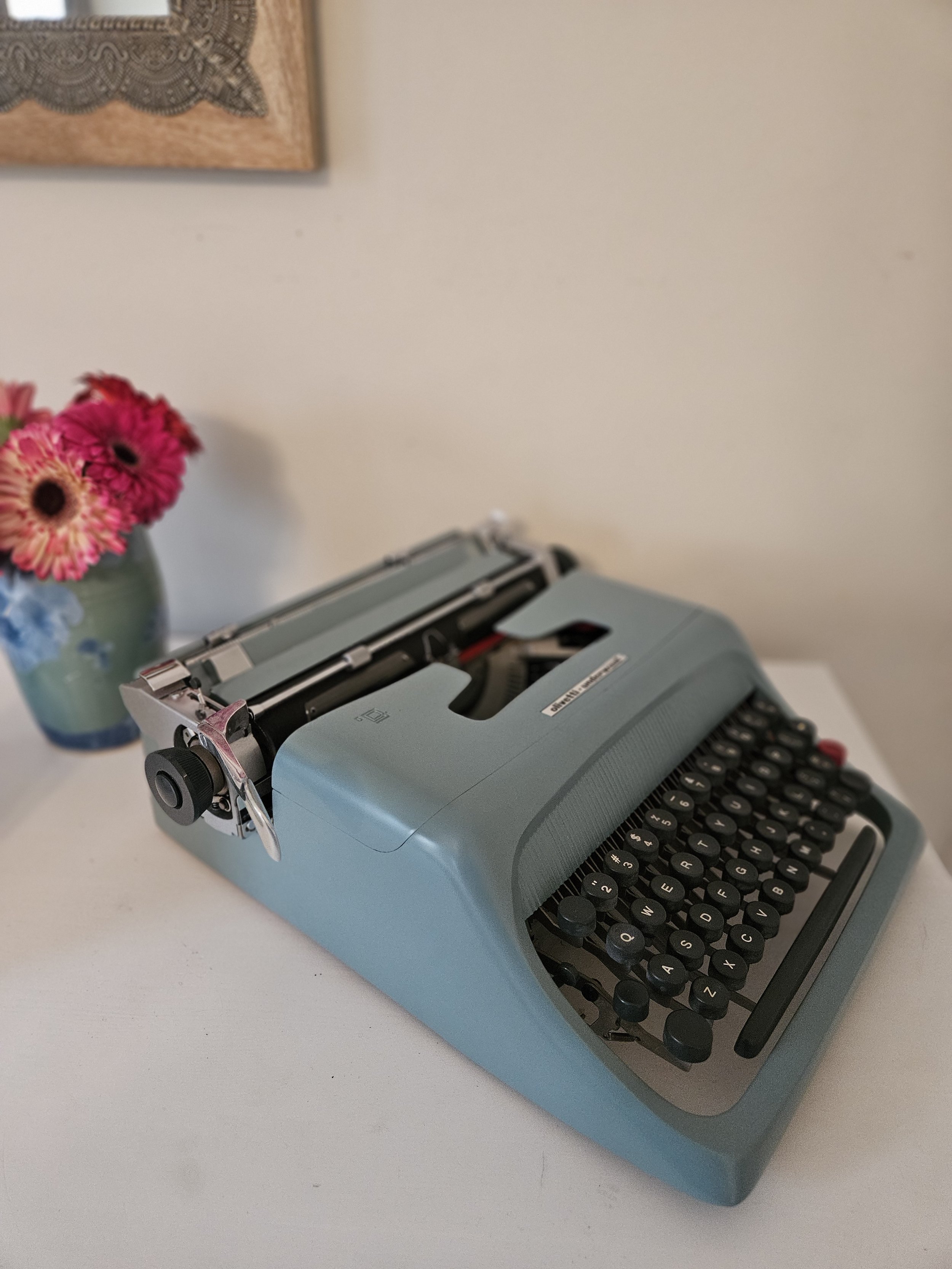

Welcome to one of history’s finest typewriters, lovingly restored for your writing pleasure.
Order now. In about 2 weeks, you’ll get a stunning, authentic, lovingly-restored specimen of this model in the condition selected.
***
There could be slight variations. The typeface will be either 12cpi or 10 cpi (10 or 12 pt font, or thereabouts).
The Olivetti Studio 44 is a mid-century Italian typewriter renowned for its solid construction, elegant design, and smooth typing experience. Introduced in 1952 and produced until the early 1960s, it was positioned as a high-end portable model, bridging the gap between smaller, travel-friendly machines and full-sized office typewriters. Though heavier than ultra-portable models, the Studio 44 became a favorite among professional writers, journalists, and intellectuals who valued both durability and aesthetics.
Historical Background
Olivetti, an Italian company founded in 1908, was at the forefront of typewriter innovation throughout the 20th century. By the 1950s, Olivetti had gained international acclaim for its machines, thanks to cutting-edge industrial design and meticulous engineering. The Studio 44 was designed by Marcello Nizzoli, the same designer behind the famous Lettera 22 and Lexikon 80 models.
During its production run, the Studio 44 became a trusted tool for many writers and creatives who needed a reliable, full-featured machine. It was larger than the Lettera series but smaller than standard office typewriters, making it a unique blend of portability and stability.
Design & Build
Manufacturer: Olivetti (Italy)
Model: Studio 44
Years of Production: 1952 – early 1960s
Type: Portable, though relatively large and heavy for this category
Designer: Marcello Nizzoli
Construction: Cast aluminum body with metal internal mechanics
Weight: Approx. 19.4 lbs (8.8 kg)
Size: Larger than most portables but more compact than standard office machines
Color Options: Typically found in muted tones like light gray, blue-gray, and greenish-gray
Aesthetic: Classic mid-century Italian industrial design—sleek yet highly functional
Typing & Mechanical Features
Key Action: Smooth and responsive, providing a firm and satisfying feel
Typebars: Well-engineered with a relatively light touch for a typewriter of this size
Platen: Standard rubber, with manual adjustment knobs for precision
Ribbon Mechanism: Uses a two-color ribbon system (typically black and red)
Carriage Return: Lever-operated, smooth, and efficient
Typing Speed: Faster than many earlier portables due to refined mechanics
Segment Shift: Unlike heavier basket-shift machines, the Studio 44 has a segment shift, making capitalization and special character typing easier and less physically demanding
Notable Features
Full-size Keyboard: Well-spaced, comfortable keys with deep key travel
Margin Release & Tabulator: Allows for more flexible formatting
Paper Support Arms: Helps hold longer sheets in place
Platen Knobs: Both sides have platen knobs for easy paper alignment
Ribbon Selector: Lets users switch between two ink colors or stencil mode
Carriage Lock: Useful for transport and storage
Case & Portability
Though technically a portable typewriter, the Olivetti Studio 44 is heavier than most portables at 19.4 lbs (8.8 kg). However, it comes with a sturdy carrying case designed for protection and transport.
Case Material: Rigid, often with a leatherette or textured finish
Latches: Typically metal with a secure locking mechanism
Handle: Designed for comfort but best suited for short-distance carrying
Dimensions with Case: Approx. 16” x 14” x 6” (40 cm x 35 cm x 15 cm)
The case provides protection but does not make it an easy travel typewriter compared to smaller models like the Olivetti Lettera 22. It was ideal for those who needed a semi-portable workhorse, moving it between locations rather than carrying it daily.
Famous Writers Who Used the Olivetti Studio 44
Several well-known writers and creatives used the Olivetti Studio 44, appreciating its reliability and smooth typing experience:
Tennessee Williams – The famous playwright behind A Streetcar Named Desire and The Glass Menagerie was known to use an Olivetti Studio 44 for drafting his works.
Leonard Cohen – The celebrated poet, novelist, and singer-songwriter used a Studio 44, particularly during his early years as a writer.
Patricia Highsmith – The acclaimed mystery and psychological thriller writer (The Talented Mr. Ripley) was known to use an Olivetti, with the Studio 44 being one of her possible models.
Final Verdict
The Olivetti Studio 44 is an outstanding choice for writers who prefer a sturdy, full-featured typewriter with a smooth and effortless typing experience. While it is heavier than ultra-portable models, its solid construction, timeless design, and ease of use make it a beloved classic.
If you’re looking for a reliable typewriter with a touch of Italian craftsmanship, the Studio 44 remains a fantastic choice, particularly for those who do serious, long-form writing.
Would you like help finding one, restoring one, or learning more about its care?
BUY with CONFIDENCE...
Please let me know if you have additional questions.
Most sincerely,
Steven Budden Jr.
Classic Typewriter Co.
Chapel Hill, North Carolina
RESOURCES
WHAT SETS US APART
Our Promise | Warranty | Working Guarantee | Lifetime Tradein Policy
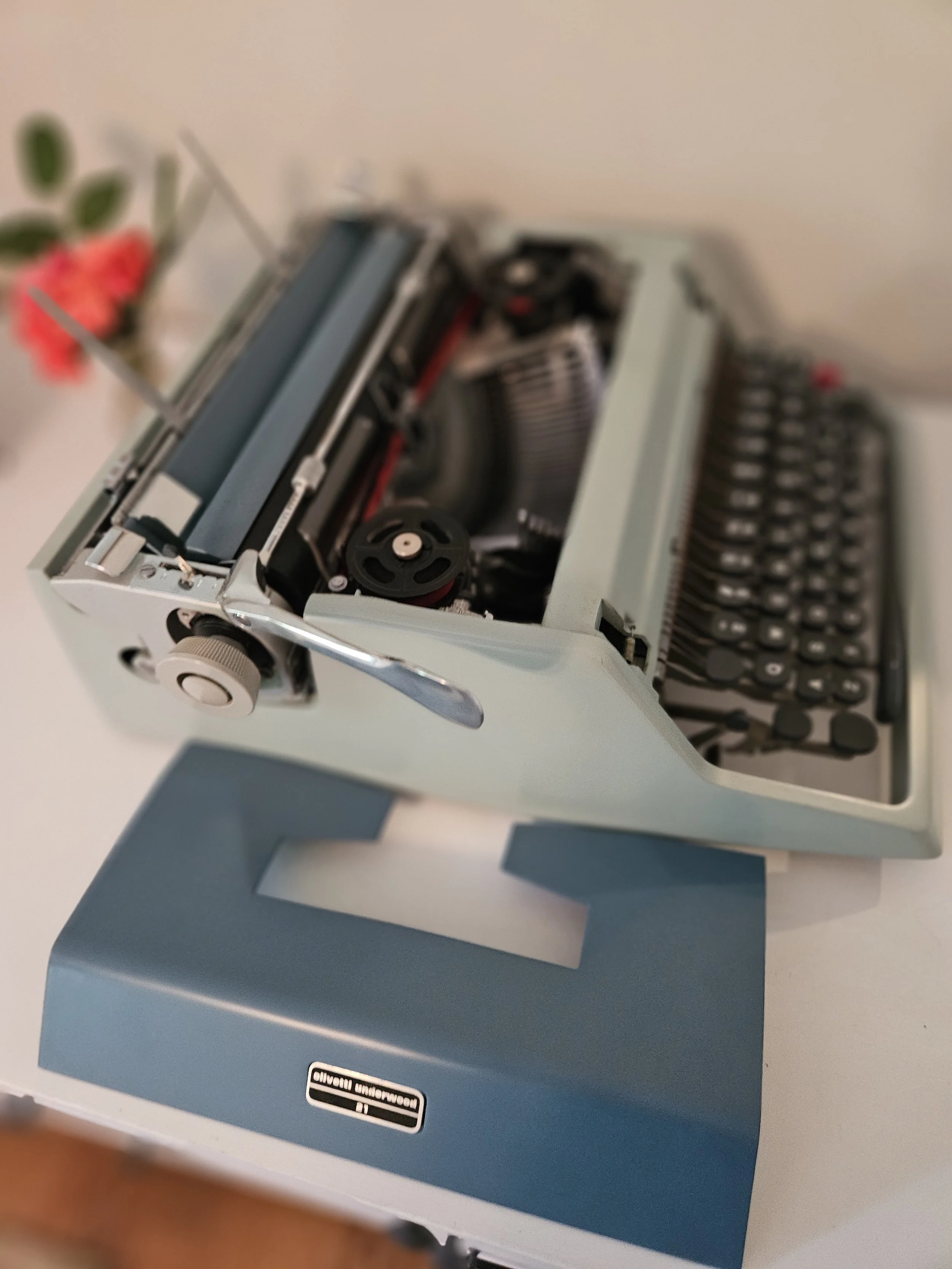
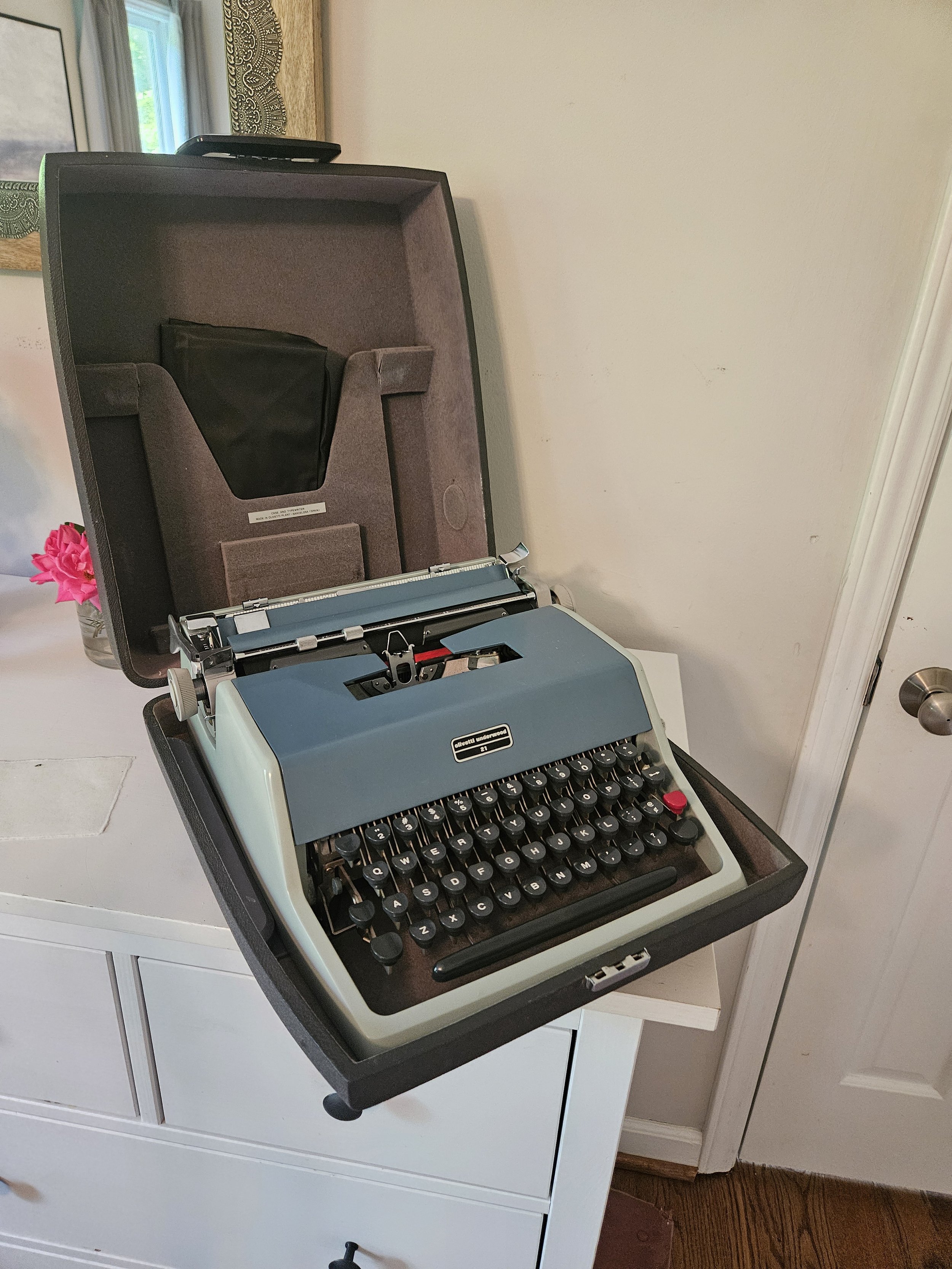
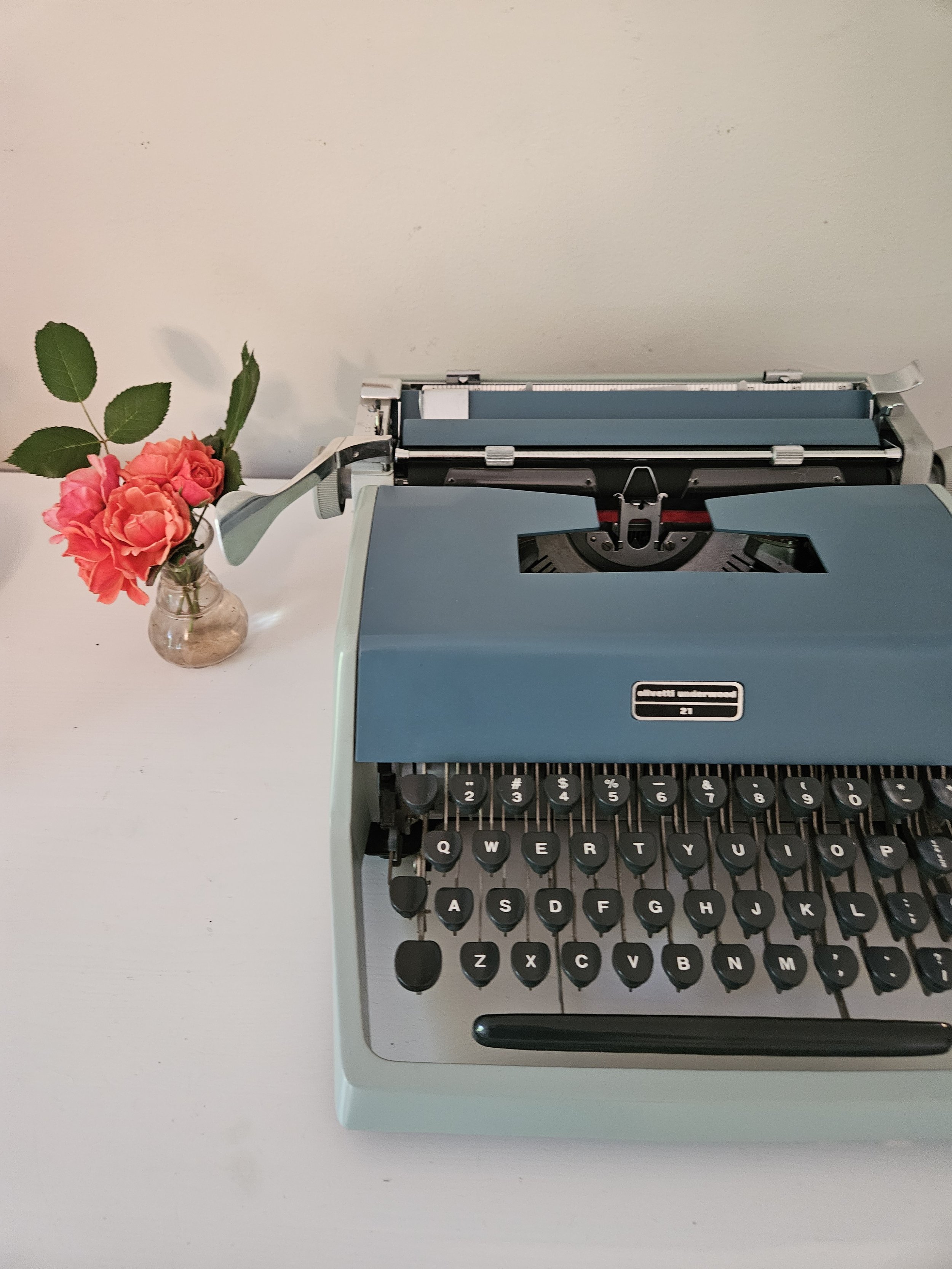
Welcome to one of history’s finest typewriters, lovingly restored for your writing pleasure.
Order now. In about 2 weeks, you’ll get a stunning, authentic, lovingly-restored specimen of this model in the condition selected.
***
The Underwood Olivetti Studio 21 bridges the gap between the smaller Lettera 32 and the larger Studio 44.
It was made in the late 60’s, for about 5 years, in the Olivetti plants, one of which was in Barcelona Spain, another in Ivrea, Italy.
You’ll see them in Olivetti, Underwood, and both, as the brands merged.
The Studio 21 features keys shaped like fingernails or tombstones, which provide a comfortable and ergonomic typing experience.
A standout feature is its ability to indent paragraphs automatically. By holding the margin release button during a carriage return, the machine indents five spaces from the left margin, eliminating the need for manual spacing or tabbing
The Studio 21 includes a half-space feature that allows users to insert missing letters into already typed text with precision, making corrections easier than on many other typewriters
Users often praise the machine for its consistent touch and feel. It regulates typing energy to produce uniform imprints, even compensating for lighter key presses. This results in clear and aligned text without variations in darkness or frequent jamming of type bars
It also offers multiple line space settings (x4) and a rigid construction that is hard to match in a portable; and this includes the tough as leather case.
The Studio 21 is known for its robust construction and precise mechanics. It has a certain unmistakable feel. The print is top notch and the alignment rivals any machine.
US QWERTY keyboard.
PICA or Elite typeface.
Features (all working as designed):
Single, Double, 1.5 line spacing, and a WIDE spacing. (manual says between 5mm and 12.5mm)
Ringing nd of line bell
Manual and Auto ribbon reversal
New ribbon installed
Tab set and clear keys
Touch control
Left and right margins
Retractable paper support
Changeable type with standard included
Left side page guide
Enclosed bottom cover
Original metal case
Standard PICA or Elite typeface.
If you're looking for a machine to write on, this is it!
***
Please let me know if you have additional questions.
Most sincerely,
Steven Budden Jr.
Classic Typewriter Co.
Chapel Hill, North Carolina
WHAT SETS US APART
Our Promise | Warranty | Working Guarantee | Lifetime Tradein Policy
RESOURCES
You’ll notice that we offer machines in two conditions. Here is an overview of why and how that works.
It’s not just easy on the eyes.
Here are a few critical considerations…
The Shift.
This is something that we mostly take for granted in the digital age.
On a manual typewriter, a ‘shift’ actually requires a change of position of the carriage or the type bars; a LITERAL shift. On Modern Typewriters, the slug contains a few characters: a capital letter, a lowercase letter, or a number and a special character. It varies some.
Here’s an example, an extreme close up of a Smith Corona Silent:

Shift Example Videos
In the world of manual typewriters, there are… 3 Mechanisms that make the shift happen. Or three ways to shift.
The ‘Carriage Shift’. The carriage shift was fairly standard on most designs until the 60’s (though the Smith Corona ‘Floating Shift’ models (which I include on this site) are a rare exception. This means that pressing the shift key lifts the carriage with the platen and rollers that holds the paper, so that the lower-case letter strikes the platen. In this case, shifting is a rather cumbersome task, as the pinky, usually assisted by some spring mechanism, needs to put some effort in to lift a 1 lb carriage.
It's an important consideration if you'll be typing quickly, because shifting takes a lot of key pressure to lift the x, and sometimes, if you don't do it all the way, you'll get a letter that is lower than the others. It’s a skill, and also a design flaw.
For plodding out poetry, or for correspondence and shorter works, the carriage shift may make little difference to you. I love the Olympia SM 3 and SM 4 for style and usability, however, it wasn’t until the SM9, which is more industrial minimalist, finally incorporated the carriage shift.
The ‘tilt’ shift. This is a term I made up. It is technically a carriage shift, but the carriage merely tilts instead of moving, so that the front of the carriage moves up to compensate for the capital letters, while the rear is static, on a hinge. This is only found in smaller machines, notably the Hermes Baby Type Writer.
The ‘basket’ or Segment Shift. Most people refer to it as a basket shift, though typewriter aficionados have consistently told me that ‘segment shift’ is the way they learned it. The point is, instead of the whole carriage moving, just the type bars move. This makes for a very fluid and fast shift. Again, Smith Coronas were the earliest models to incorporate this feature in the 30’s. The rest caught up in the 60’s.
Tabs
More modern machines have pretty reliable tabulators, meaning you can set the tabs and margins wherever they are needed. Some don’t have any at all, like the stunning Groma Kolibri. For poetry, you may not care, but for most of the world this becomes a fatal flaw.
Some machines, like the Smith Corona Sterling Silent, The Remington Noiseless(es), and any early Corona…. they need the physical tabs moved at the rear. These are removable and often lost.
Those that need to adjust the tabs regularly may prefer an Olivetti Lettera 32, which has buttons on the keyboard which set and clear tabs.
See video below for examples:
Typewriter Keys
They come in many shapes and sizes


Of course, all of the typewriters I’m referring to here have keys available in the standard Querty layout. Be careful with this because many European machines will come with a QWERTZ keyboard. That refers to the layout of the keys, and in the US you’re probably used to QWERTY. Many of us have tried to use a QWERTZ to get a great deal on a machine, only to find ourselves waffling. (guilty?)
(QWERTY btw refers to the order of the first characters on the first row of letters).
[This is the type of ‘problem’ we’ve already solved for you on this site]
Some keys are more are more comfortable for long sessions. Some are more ergonomic. The Olympia SM machines have springs beneath each key which is supposed to soften the repeated impact. Other machines don’t, though various engineering practices make them more comfortable to touch. Some are flat and some concave, to accommodate the fingertips. Some, like the Olivetti Studio 44, have a keyboard with a slightly larger profile, which can be good for large hands.
The Materials
During the golden era of typewriters, the machines were built to last a lifetime. In most cases, these machines have outlived their original owners and will continue to do so.
However, in the 80’s and 90’s, the throwaway mentality was born. People turned to computers, and it seemed that technology only needed to last until it was obsolete, and then it would be relegated to the landfill. A lot of otherwise useful typewriters from these time frames I tend to shy away from, because they are full of plastic. Not that there is anything wrong with plastic… but if I can get the same elegant, precision chassis with a metal frame, I’ll choose that. They are more durable, more reliable, and more beautiful. It just feels more visceral somehow to prop a solid object onto the table for a writing session. So while some decent machines were being manufactured in the 80’s, the Golden Era had already passed.
The Cost
I’ve gotten a Lettera 32, a pair of crutches, and a chair for $15. I’ve also bought a non-refurbished Lettera 32 for $700, because I needed a keyboard layout at the request of a client. Some vendors and hobbyists show photos of them complete dismantling typewriters; it’s a neat photo and they don’t do it for every machine, obviously. Or they’d be broke and go crazy. Also, I get a lot of these later, and they aren’t put together exactly right. Oops. Taking a typewriter apart is fun! The other way, not as much.
People will write me: I found a ‘Remington Noiseless for $40 at a thrift store! Ha!’ I’ll say, sweet! Write something with it and come back to me. Ghosted! They almost always need new feet and rollers to function, though they often look perfection itself. Rubber gets crushed and flattens over time. Sometimes it liquefies.
The main thing is: you can get machines that work, or machines that ‘work’ ( ie they don’t really work). They work well enough to someone to say ‘working’ but then when you go to use it, three lines in something doesn’t work, a key is disconnected, the tab gets stuck, the drawband falls off, whatever.
If you buy from someone online, most people have no idea what they have or what they’re selling. They don’t actually know if the machine works, because they don’t know what it’s supposed to do (other than make letters). In fact, I didn’t know how a typewriter felt when I was starting out. The first ones were grueling. Later, I learned, ah, this is what a beautifully running, gorgeously engineered machine feels like. Writing is a joy again.
At Classic Typewriter, we strive to balance usability and cost. We have our repairmen, with decades of experience, working out the more difficult kinks. We replace parts as needed, and as desired on the BEST models.
When you need a working machine now, I firmly believe we’re one of the best choices. Especially after testing twenty different technicians by ordering their machines. They almost all required additional work to be Classic Typewriter worthy!
Some people fall into the trap of shopping for the perfect machines, and they never actually write. This is their prerogative, but I hope this doesn’t happen to you!
We include a 1-3 year warranty and a video tutorial, a lifetime trade in policy, and the comfort of knowing your machine will work.
Portability
Some machines fit in a small suitcase (ultraportables). Others fit on a desk and are portable in a case, but not exactly light, weighing in at over 20 pounds. Still others weigh 50 pounds are are not meant to be removed from the desk. These are all viable options.
Generally, I suggest the general ‘portables’. The middle size. These balance reliability and portability in a beautiful way. If you’re mostly traveling, I’d suggest an ultra portable. They aren’t quite as joyous to type on, in my opinion, but they can be wonderful and inspiring. The Hermes Baby and the Groma Kolibri comes to mind.
Sources of Typewriters
You can find lower cost typewriters in various places, including flea markets, online auctions, goodwill, antique stores, etc. I recommend scouting for deals! However, if you can avoid it, it is a huge rabbit hole and generally a waste of time and money. Great for people that want a lot of non working typewriters sitting around and don’t have much urgency to get to writing.
But they’ll all come with challenges when it comes to actually using them.
If you want to get to writing SOONER, order one here or from another reputable dealer.
Catching your dream early; priceless.
What Sets us Apart
Here, at Classic Typewriter, we makes sure to have our team rigorously test and adjust each machine, so that you can rest easy knowing that you're getting a machine that will be ready when the deluge of inspiration hits.
We also include a working guarantee, which means that the machine will work when it arrives.
We offer a lifetime trade-in policy, which means that you can return us your machine, and we’ll apply the amount you paid for it to a new machine of your choice (minus shipping). If it needs repairs or is damaged, we’ll factor that in as well.
Here’s an example of one of the demos, which is also a good illustration of Carriage shift and tab keys…
How to Choose
Think about the features you require (You probably won’t require most of those 95% of the time).
Find a few machines that sport those features.
Buy one from a reputable dealer (one that you’re sure will work).
Buy with your eyes, your mind, and your heart. There’s some magic that’s about to happen.
If you are called to getting more than one, you might want to read my Guide to building a Stable of Typewriters.
If you have questions, click the button below and ask… (I’ll get back to you soon, though I spend glorious time off of screens, so not too soon)
Aka… I don’t know the answer, but I’ll ask Chat GPT and get back to you.
NO! For the one thing, it doesn’t know much about typewriters, and for another, I love human to human connection.
Listen, that's the clack of the typewriter you can't get out of your head. Invite it into your life already, and become what you were meant to be.
Order your new mechanical companion today.
With Classic Typewriter, it’s not just a writing machine… it’s a partnership.
Steven Budden Jr.
Classic Typewriter Co.
Chapel Hill, NC

Steven Budden, Screenless Writer