
Why a Typewriter Helps with Writing (and staying human)
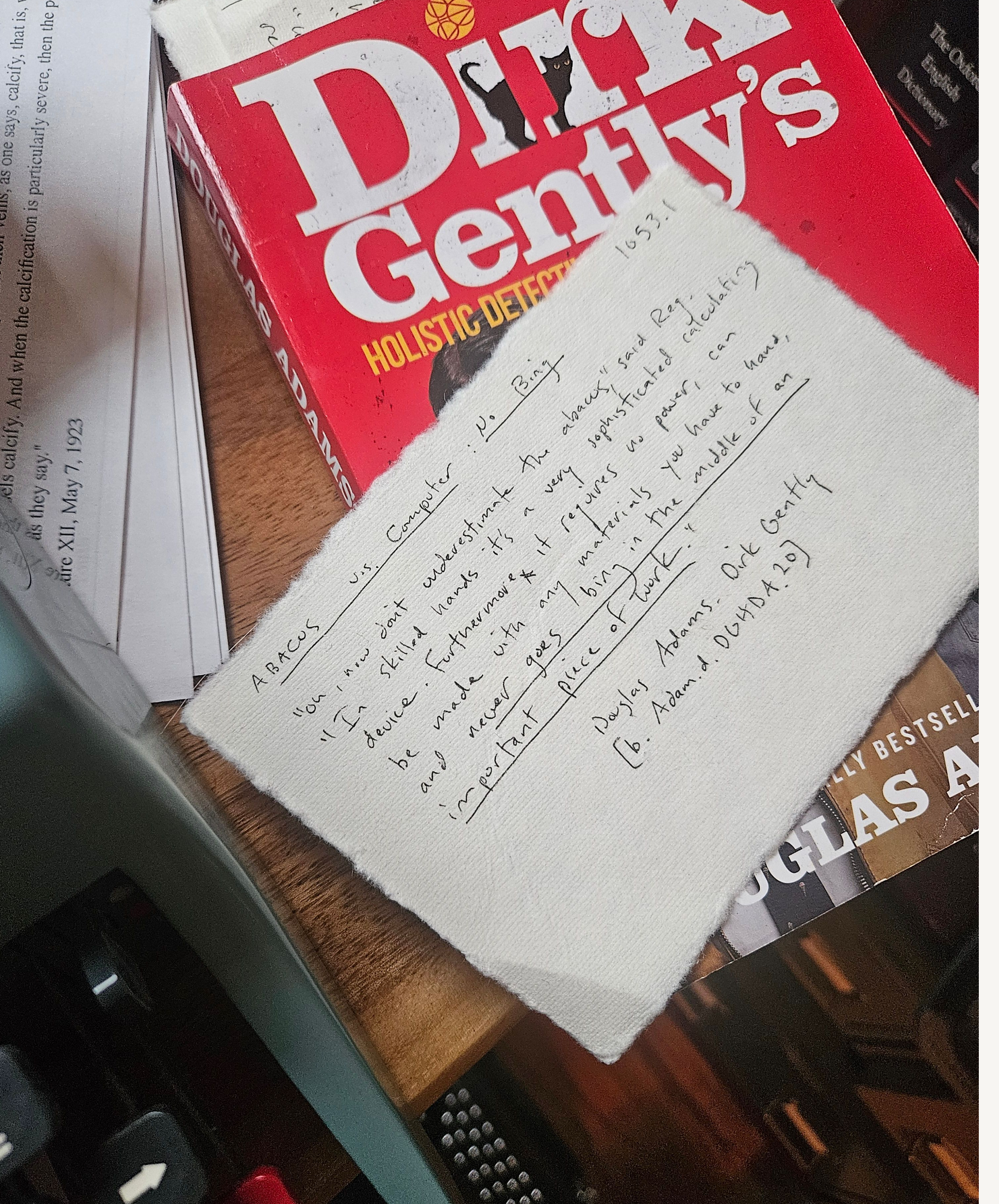
There's a funny quote from Dirk Gently's Holistic Detective Agency (which I'll show here on one of my NEXUS cards).
It goes:
"So I used to spend days struggling to write essays on this 16k machine that would have taken a couple of hours on a typewriter, but what was fascinating to me was the process of trying to explain to the machine what I wanted it to do. I virtually wrote my own word processor in BASIC. A simple search and replace routine would take about three hours."
"I forgot, did you ever get any essays done at all?"
"Well, not as such. no actual essays, but the reasons why not were absolutely fascinating."
Of course, this is fiction and computers have evolved. But the fundamental problem remains.
We tinker around, optimize, schedule, plan, and this overtakes the writing itself.
A page earlier, Douglas Adams writes:
"Oh, now don't underestimate the abacus," said Reg. "In skilled hands it's a very sophisticated calculating device. Furthermore it requires no power, can be made with ay materials you have to hand, and never goes bing in the middle of an important piece of work."
This is the main thing, isn't it? The human mind is so susceptible to distraction, that the bing can throw us off into hours of distraction. It's like using a phone to check the time.... oh, also, the messages, and then socials, and the orders, and the emails... what used to take seconds on a watch is now a 15 minute journey into God knows where.
This is why I advocate, in The Screenless Writer (upcoming book), to separate the tools again. A watch for time, a typewriter for drafting, a pen for editing. The more we attempt to simplify (optimize) our lives into one tiny digital box, the more trapped we become. The more mired in trivia. And the less of our seminal work, the writing, gets done.
In Anthroposophy the opposing forces that humans grapple with are referred to as Luciferic and Ahrimanic. One is untethered 'free' spirituality without a ground, and the other is god-less materialism without a spirit. Humans delicately walk between these two poles, in their idea state of health and balance.
The typewriter is poised to activate each force equally, so at its center, I mean, at the keyboard, a human can be a free flowing source of creative force, continually returning to the body again and again via the kinesthetic cues that the typewriter brings to the equation.
The lack of electricity on the manual tilts it a little more to the Luciferic, which, in truth, many people need to drift closer toward. (Some compare these two forces to Yin and Yang... people need more Yin).
Drifting from screen to screen while dreams die in a digital world is what Steiner, the founder of Anthroposophy, would call an Ahrimanic affliction. The associated diseases are tumors, cancer, arthritis, and other ailments of 'hardening.' (By the way, if you're Christian, Steiner talks about the Christ force as being the balancing force, or what Buddha called 'the middle way.)
In any case, my main concern is remaining human and helping others do the same.
The typewriter as a ritual object on the desk supports this endeavor as well, for me, because a pen gets lost in the drawer... I can doodle with it or do math with it. It's not strictly a writing instrument (though I use one at least daily). The typewriter is ever present, with weight, beauty, inspiration, historical context... it sits there beckoning, always. It reminds me of this identity and human-writer, in a world where tech moguls want to sell you their ai writing app.
Which is the reason also why I got this 20 volume Oxford English Dictionary to continually awaken me from the digital dream, like a totem. When I thumb through the pages, I encounter words with my whole body, rather than just a flicker at the eyeballs.
I've been building my analog, paper based learning system, NEXUS, with great trial and tribulation. With every card, I learn more about the system and about myself. It's difficult, because of the digital magnetizing force. It's essential for the same reasons.
I want to remember how my mind works when it is free, and facilitate that process into the future.
So just keep writing, and write with the body, mind, and soul. Let the creative spirit soar, and also infuse the work with will.
Write on, my friend.
Steven
The Classic Typewriter Company
PS. If you have a machine in queue, rest assured we're working on it now.
PPS. We have Entry Level machines back in stock finally after a Christmas wipe-out.
And here is some eye-candy for the parting. A Letter 32 in stunning array. These have one of the lightest action of any manual, in m y opinion.
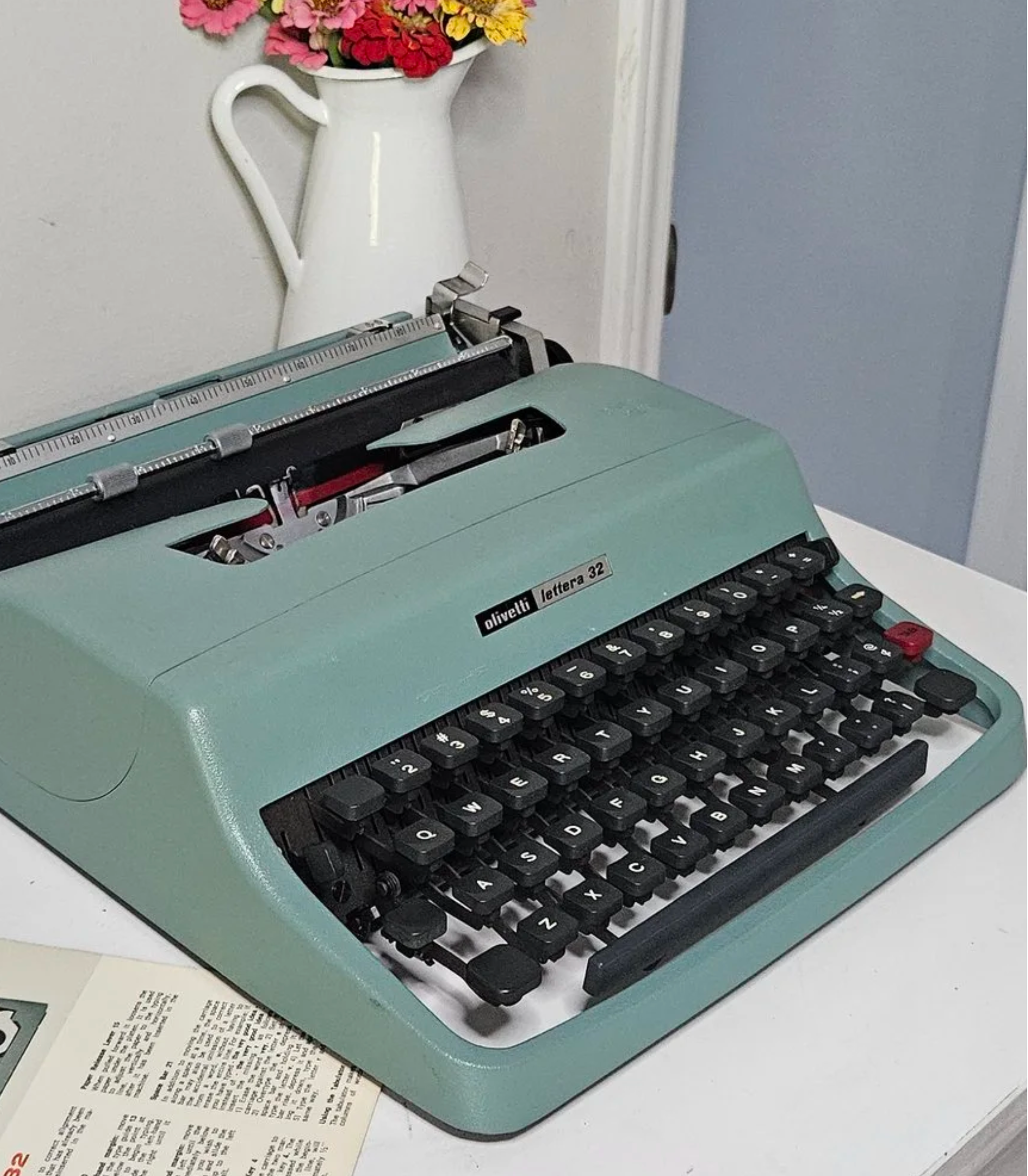
Lettera 32