
Theodore Dreiser: The Writer Who Succeeded Despite Everything — Including Himself
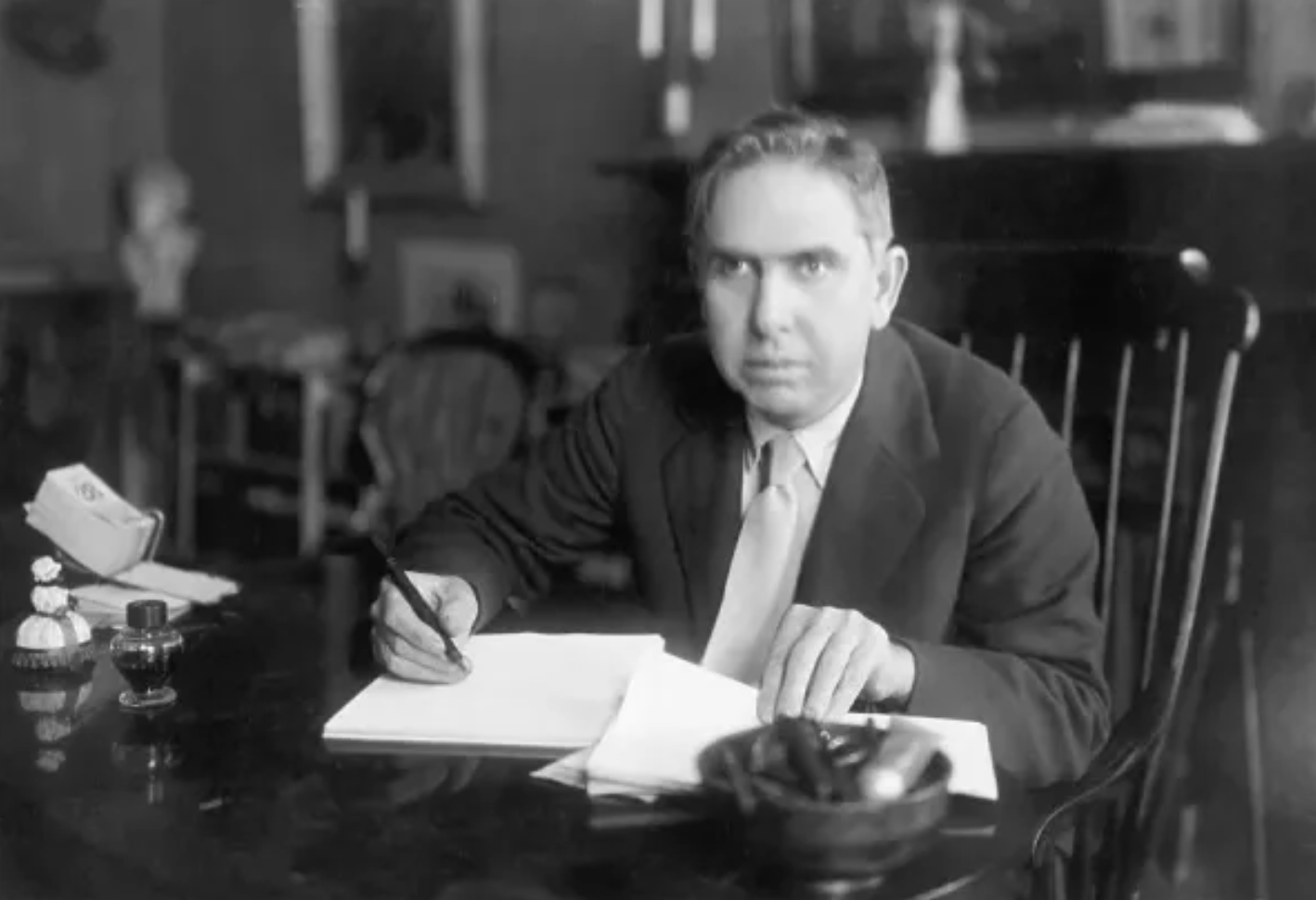
Theodore Dreiser
There is a recurring puzzle in American literary history: Theodore Dreiser wrote some of the most powerful fiction the country has ever produced, and he wrote it badly.
Not metaphorically badly. Actually badly. H.L. Mencken — his greatest champion, the man who called him the most important American novelist since Mark Twain — also said Dreiser had "an incurable antipathy to the mot juste." In An American Tragedy, Dreiser describes a death-row cell as "one of those crass erections and maintenances of human insensibility and stupidity for which no one was primarily responsible." Critics have been baffled by sentences like this for a century. The phrasing is terrible. The effect is devastating. Nobody has ever satisfactorily explained how that works.
Dreiser is worth studying not because he was technically accomplished — he wasn't — but because he was truthful in a way that technique apparently cannot produce. And his life, his habits, his research methods, and his relentless commitment to finishing things despite every conceivable obstacle contain more useful instruction for a working writer than a shelf of style guides.
The Family He Was Born Into
Dreiser was born in 1871 in Terre Haute, Indiana, the ninth of ten surviving children in a German immigrant family of disastrous financial instability. His father was a strict, humorless Catholic millworker who rarely had steady employment. They moved constantly — between small Indiana towns, between rented rooms, between cities — chasing cheaper rent.
His siblings were extraordinary raw material. One sister, Emma, ran off to New York with a married man who had stolen money from his employer to finance their escape. She became the direct model for Carrie Meeber in Sister Carrie. Another brother, Paul, ran away with a minstrel troupe, changed his last name to Dresser (slightly, to differentiate himself from the family shame), and became one of the most successful Tin Pan Alley songwriters in America. Paul Dresser wrote "On the Banks of the Wabash, Far Away," which sold more sheet music than almost any song of its era. The family that produced one of America's great tragic novelists also produced one of its great popular songwriters. Neither brother started with advantages.
Theodore left home at sixteen. He worked in a warehouse, spent exactly one year at Indiana University before running out of money, worked as a clerk and a collections agent in Chicago, and then became a newspaper reporter — in Chicago, St. Louis, Toledo, Cleveland, Pittsburgh, and finally New York. It was a grinding, hand-to-mouth decade. And it was the education that produced everything.
What the Newspapers Taught Him
Journalism in the 1890s was not a craft that encouraged literary sensitivity. It rewarded volume, speed, and a direct relationship to fact. Dreiser interviewed Andrew Carnegie, Marshall Field, and Thomas Edison. He covered murders, fires, poverty, tenements. He was paid to see the world clearly and record it without sentiment.
This is where his prose style was formed — and where its peculiarities took root. A journalist who has to produce copy on deadline does not develop the habit of polishing sentences. He develops the habit of finishing.
At twenty-one, broke and miserable as a bill collector in Chicago, he described newspapers as "wonderlands in which all concerned were prosperous and happy." He was wrong about that. But his hunger to enter that world — to be, as he put it, "seen and understood for what I was — a writer" — drove him across eight cities in eight years before he sat down to write his first novel.
When a friend convinced him to try fiction in 1899, Dreiser sat down and wrote Sister Carrie the way he filed newspaper copy — from observation, from research, from direct personal knowledge of poverty and desire. He didn't build a beautiful structure. He built a true one.
The Lumbering Prose Is the Point
Let us spend some time here, because this is where most readers misunderstand Dreiser — and where his work has the most to teach.
The standard criticism is that Dreiser's sentences are slow, repetitive, and clumsy. That he returns to the same word three times in a paragraph. That he explains what he just showed you. That the prose creaks forward like a cart on a bad road.
All of this is true. And it is precisely why the books work.
Dreiser wrote about people for whom life moved with terrible effort. Poverty does not move quickly. Desire does not resolve cleanly. The experience of being poor, ambitious, and trapped in circumstances you didn't choose is not a swift experience — it is an accumulating one. Each day adds its weight to the previous day. Each small humiliation sits on top of the last. The distance between where you are and where you want to be does not close; it opens.
When you read Dreiser slowly — when you do not fight the pace of his prose but move with it — something strange happens. The resistance in the sentences starts to feel like the resistance in the lives he's describing. You are not reading about Carrie Meeber's longing from a comfortable distance. You are inside the temporal weight of it. The longing accumulates the way it actually accumulates: slowly, without relief, without the merciful compression of elegant style.
Hemingway said that prose should move like water. Dreiser's prose moves like a person carrying something heavy. And for his subjects — the trapped, the striving, the slowly ground down — that is the honest description.
Mencken understood this even while mocking it. He wrote that Dreiser had "an aluminum ear" for language, and yet concluded that Dreiser's work differed from everything before it the way biology differed before and after Darwin. The clunkiness and the greatness are not in spite of each other. They are the same thing seen from different angles.
There is a deeper argument here that no one has made cleanly enough: Dreiser's prose enacts his philosophy. He was a determinist. He believed, following Herbert Spencer, that human beings are shaped by forces they do not understand and cannot control — heredity, economics, desire, social pressure. His characters are not choosing their fates; they are being carried by them. And the prose moves the same way. It doesn't spring forward. It doesn't conclude. It accumulates and continues, pushed by its own weight, until it stops.
The death-house sentence that critics quote as evidence of his clunkiness — "one of those crass erections and maintenances of human insensibility and stupidity for which no one was primarily responsible" — is, when read carefully, a perfect Dreiserian statement. The institution is guilty. No individual is guilty. The stupidity is systemic. A cleaner sentence would have been a lie.
Five Quotes Worth Sitting With
Dreiser at his best wrote sentences that land without decoration:
On the limits of language:
"How true it is that words are but the vague shadows of the volumes we mean." — Sister Carrie, 1900
He wrote this in his first novel, before he had any reputation to protect. It reads like a man who has already made his peace with the gap between what he can say and what he means.
On art and suffering:
"Art is the stored honey of the human soul, gathered on wings of misery and travail."
This is the most compressed and beautiful thing he ever wrote, and it took him the entirety of his life to earn the authority to say it without sentimentality.
On the stony universe:
"Let no one underestimate the need of pity. We live in a stony universe whose hard, brilliant forces rage fiercely."
Every one of his novels is an argument for this sentence.
On the newspaper years:
"Life is a God-damned, stinking, treacherous game and nine hundred and ninety-nine men out of a thousand are bastards." — Newspaper Days, written c. 1910
This is not cynicism. This is a man who covered the industrial cities of the Gilded Age from the inside and reported back honestly.
On himself, with the only grace note he ever allowed:
"Theodore Dreiser should ought to write nicer."
He actually said this. About himself. The grammar is typically his. The self-awareness makes you revise everything you thought you knew about how unconscious his style was.
How He Actually Wrote: The Physical Record
The specific daily schedule of Dreiser's writing life is not as meticulously documented as Hemingway's dawn sessions or Trollope's word-count quotas. What the record shows is a man who wrote in sustained, sometimes marathon sessions — and who required external pressure to begin.
Sister Carrie was written largely in 1899 at the urging of his journalist friend Arthur Henry, who essentially refused to let him stop. Dreiser would write several pages, declare himself blocked, and Henry would push him back to the desk. The book was drafted in roughly five months. Dreiser wrote at night, after the day's distractions had settled — a habit that fits a man trained in the evening newspaper culture of the 1890s, where deadlines came after dark and the real work happened when the street noise dropped.
For An American Tragedy, begun in 1920, abandoned in 1921, and returned to in 1923, the process was more collaborative. He worked with two editor-secretaries, Louise Campbell and Sally Kusell, alongside his future wife Helen, who helped him manage the sheer volume of material — court records, newspaper clippings, notebooks full of research accumulated over years. What the University of Pennsylvania archives record about his work habits in general is significant: Dreiser regularly had manuscripts "retyped under his name before submitting to a publisher." Writing and typing were separate acts, often performed by separate people.
This is important context for the typewriter question.
Dreiser and the Typewriter: What the Record Shows (and Doesn't)
No documented quote from Dreiser about typewriters has survived in the accessible record — or at least none that has entered the literary canon the way Hemingway's remarks about his daily word count have, or the way Cormac McCarthy's defense of his Olivetti has.
This silence is interesting in its own right.
Dreiser worked as a professional journalist from 1892 to 1899. Typewriters were the standard instrument of every newsroom he passed through — the Chicago Daily Globe, the St. Louis Globe-Democrat, the Pittsburgh Dispatch, Pulitzer's New York World. He would have typed, or worked alongside people who typed constantly, for the better part of a decade. It is simply not possible to have been a working American journalist in the 1890s without being surrounded by the machine.
When he became a novelist, the pattern the archives reveal is consistent: handwritten drafts or longhand composition, then secretary-typed clean copy, then revision. He was a dictator as much as a typist — a man who generated prose and had others capture it in final form. His editor-secretaries on An American Tragedy, Louise Campbell and Sally Kusell, worked with the typed manuscript directly. The Penn archives specifically note that essays he conceptualized were sometimes "written by others, retyped under his name."
The typewriter, for Dreiser, was not a personal instrument in the way it was for his contemporaries who sat alone at a desk. It was part of a collaborative production system — the machine that stood between his handwritten accumulation and the publisher's page. He orbited it rather than owned it. This is consistent with everything else we know about him: a man more interested in the mass of material than in the elegance of the final artifact.
What Photographs of Dreiser Tell Us
The surviving photographic record offers what no biography quite captures: the physical man in his physical environment.
The most widely reproduced portraits are Carl Van Vechten's 1933 session, taken when Dreiser was 62 and at the peak of his fame. He is heavy, square, almost architectural in his stillness. He fills the frame without trying to. There is nothing of the literary dandy in him — no studied languidness, no prop cigarette. He looks directly into the camera with the expression of a man who has spent forty years watching other people carefully and has no interest in performing for this one.
The working photographs are more revealing. A 1931 image shows Dreiser in his penthouse apartment on West 57th Street — the one he bought with movie rights money from An American Tragedy. His workspace is visible in some of these images: stacked papers, books in disorder, the accumulated material of a man who saved everything. The Penn papers catalogue confirms this physical density: his filing practices were elaborate, his recycling of material constant. He was a hoarder of his own output in the way that journalists become — saving clippings, keeping carbons, maintaining folders of work that might be reused.
A 1938 photo at Iroki, his Westchester estate, shows him with his secretary-research assistant Harriet Bissell. This is the image that tells the most: a man in his late sixties, still with an active secretary, still generating material, still requiring someone to capture what he produced. Iroki itself — purchased in 1927 after the sale of An American Tragedy film rights — was a substantial property in Mt. Kisco, where he worked and kept company with figures including Charles Fort (the anomalies researcher) and Edgar Lee Masters (the poet). There is also a short film of Dreiser at Iroki, held in the Penn archives, which reportedly shows him on the estate grounds: a large man, slow-moving, comfortable in his own territory.
The photographs of Dreiser never show him in the romantic posture of the solitary genius at the machine. He is always in relationship — with his estate, his secretary, his visitors. The work happened in that relational field, not in isolation at a desk. Which is perhaps why the machine itself left no mark on his mythology.
Sister Carrie and the Suppression That Nearly Killed Him
Sister Carrie was published in 1900 by Doubleday. Frank Norris, then working as a reader for the house, was electrified by the manuscript and pushed for publication. Frank Doubleday himself was less enthusiastic — his wife read the proofs and found the book immoral. They could not legally cancel the contract, so they fulfilled it in the narrowest possible sense: they printed a very small run, did almost no advertising, and sent out as few review copies as they could manage.
The book sold 456 copies. Royalties totaled $68.40.
What followed was a genuine breakdown. The combination of the suppressed novel, marital troubles, and accumulated poverty sent Dreiser into a suicidal depression that lasted the better part of two years. He wandered. He couldn't write. His brother Paul — the songwriter, flush with his Tin Pan Alley earnings — found him and paid for treatment at a sanitarium. Paul Dresser died in 1906. Theodore Dreiser never forgot what his brother did and wrote about him with more tenderness than he wrote about almost anyone else.
The story has an irony that Dreiser would have appreciated: Sister Carrie was saved not by American critics but by a British edition that was received with enthusiasm in England. American publishers, seeing the English response, took another look. By 1907 the novel had been reissued, and Dreiser's reputation began, slowly, to recover.
He spent the next decade editing women's magazines — The Delineator, among others — to survive. The man who had written one of the most frank novels about female desire in American literary history was, in the interim, editing patterns for ladies' dresses.
The Vice Society and the War on His Work
Edward de Grazia's 1992 book Girls Lean Back Everywhere: The Law of Obscenity and the Assault on Genius — an 832-page chronicle of literary censorship in America — uses Dreiser as one of its central figures. De Grazia was the attorney who argued and won the Tropic of Cancer case before the Supreme Court. He knew what censorship looked like from the inside, and what he documents about Dreiser's decades-long war with the censors is both farcical and genuinely ugly.
The key antagonist was John Sumner, who in 1915 succeeded Anthony Comstock as executive secretary of the New York Society for the Suppression of Vice — an organization chartered by the state legislature, empowered to search premises, seize "obscene" materials, arrest suspected peddlers, and refer cases to criminal court. Sumner was not a fanatic in the Comstock mold; he was something more mundane and perhaps more dangerous: a bureaucrat with a mandate.
In 1916, Sumner turned his attention to Dreiser's novel The Genius, a semi-autobiographical work about an artist of "strong sexual desires." The book had sold 8,000 copies in the months following its 1915 publication. Sumner identified 75 passages he considered "lewd" and 17 he considered "profane." He paid a call to Dreiser's publisher, John Lane. Lane promptly withdrew all copies from bookstores.
Dreiser refused to make cuts. He called Sumner "one of those amateur censors who have been making such nuisances of themselves in their efforts to earn their salaries." Mencken organized a protest petition signed by over 400 writers and editors — including H.G. Wells. The Authors' League of America challenged the censorship, then lost, because the publisher had voluntarily withdrawn the book before a legal case could be brought. The League's capitulation enraged Dreiser. He wrote furiously to the League's vice president asking why neither he nor any author he knew had ever "received one word of encouragement or one dollar of cash from the Authors' League of America" in the fight against censors.
The Genius remained in storerooms until 1923, when a new publisher finally reissued it without alteration.
This was not a single episode. By the time Dreiser died in 1945, his work had been suppressed or threatened with suppression in a nearly unbroken sequence: Sister Carrie in 1900, The Genius from 1916 to 1923, An American Tragedy banned in Boston in 1927, then burned in Germany in 1933. The Nazis offered their own literary criticism: An American Tragedy was condemned for "dealing with low love affairs." That the Nazis burned it and Boston banned it suggests that Dreiser was, at minimum, hitting something real from two very different directions simultaneously.
De Grazia's argument throughout Girls Lean Back Everywhere is that the censorship of Dreiser — like the censorship of Joyce, Lawrence, Miller, and Ginsberg — was not fundamentally about obscenity. It was about the threat of accurate description. A novel that shows what American poverty actually looks like, what desire actually feels like, what the moral weight of ambition actually costs — that novel is more dangerous to an established order than any amount of deliberate provocation. The censors understood this even if they couldn't articulate it. Dreiser's "lewdness" was really his honesty.
He anticipated all of this when he wrote: "We are to have no pictures which the puritan and the narrow, animated by an obsolete dogma, cannot approve of. We are to have no theaters, no motion pictures, no books, no public exhibitions of any kind, no speech even which will anyway contravene his limited view of life." He was not complaining about a hypothetical future. He was describing his own present.
The Research Behind An American Tragedy
For years before he began writing An American Tragedy, Dreiser collected newspaper clippings about a specific kind of crime: men who murdered women — usually pregnant girlfriends, women who had become inconvenient — in order to pursue wealthier prospects. He found dozens of cases. They formed a pattern he recognized as specifically American: the dream of upward mobility so intense it consumed every other moral consideration.
The case he settled on was Chester Gillette's. In 1906, Gillette lured his pregnant girlfriend Grace Brown to Big Moose Lake in upstate New York and drowned her. Brown's love letters to Gillette were read aloud during the trial. The case filled newspapers for years. Gillette was electrocuted in 1908.
Dreiser read the court records. He traveled to Herkimer County. He studied the letters. He gave his protagonist, Clyde Griffiths, the same initials as the real killer — a private signal of fidelity to the source material. Then he took six years to write the novel.
The book is over 800 pages. It was his only bestseller. It was banned in Boston for sexual content. The Nazis burned it in 1933. Paramount turned it into a film he hated so much he sued them, unsuccessfully, to block its release.
The Quality of His Enemies
Sinclair Lewis, accepting the Nobel Prize in 1930, said Sister Carrie "came to housebound and airless America like a great free Western wind." Then, in 1931, Lewis's wife accused Dreiser of plagiarizing her writing. Dreiser, at a dinner party, slapped Lewis twice across the face. Lewis was the one with the Nobel. Dreiser was the one with the grievance. It was a thoroughly Dreiserian moment — graceless, physical, impossible to ignore.
Mencken's epitaph for him, written after his death in 1945, is the most accurate thing ever said about the man: "He was a man of large originality, of profound feeling, and of unshakable courage. All of us who write are better off because of him." Charlie Chaplin read Dreiser's own poem, "The Road I Came," at his funeral.
The last quote worth leaving you with is the one he reached for when describing not his work, but his deepest conviction about what existence costs:
"If I were personally to define religion, I would say that it is a bandage that man has invented to protect a soul made bloody by circumstance."
That sentence contains everything his novels tried to show. It is also, grammatically, impeccable. He could do it when it mattered most.
Further Reading
Sister Carrie (1900) — Start here. The restored Pennsylvania edition (1981) shows the manuscript before collaborative revision.
An American Tragedy (1925) — His masterwork. Read it slowly. The slowness is the point.
Newspaper Days (1922, republished 1931) — His autobiography of the journalism years. The best account of what made him.
Twelve Men (1919) — His most underread book. Portraits of men he admired, including his brother Paul.
Girls Lean Back Everywhere by Edward de Grazia (1992) — The definitive account of American literary censorship. Dreiser runs through it like a thread. (One of Steven’s favorite books)
Theodore Dreiser: An American Journey by Richard Lingeman — The definitive two-volume biography.