
1950’s Underwood Quiet Tab - ACE Typewriter Tutorial
Underwood Quiet Tab ACE Typewriter Video Tutorial
Welcome to your life-altering writing machine!
The Underwood Ace was built in the United States in the 1950s, during an era when Underwood set out to bring a more modern, approachable portable to market. The Ace was the simpler, more affordable sibling to Underwood's Universal. It set aside some of the extras and kept what matters: a solid, reliable machine that puts words on paper. It came dressed in the bold colors of the decade, wrapped in clean mid-century lines.
These machines arrived near the end of an era. Underwood had defined the American typewriter for half a century, and in 1959 the company came under the control of Olivetti. Machines like this one represent some of the last of the classic American-built Underwoods. Today, collectors and writers prize them for their style, their sturdy construction, and the nostalgia of 1950s American design.
Take it slowly and gently at first, and try not to force anything. Everything was tested when I sent it out, so it should be working when it arrives. I pack as carefully as possible, based on years of experience.
If something is not working as specified, we can find a solution.
That being said, each machine has its little quirks, and that is just part of writing on a functional antique. No two are exactly alike, and I say this after going through hundreds. Learning to dance with a particular machine is a process, and a worthy one!
Some people write about skipping letters or the carriage not advancing, etc. Sometimes that has to do with the mechanism. Usually it has to do with technique. It takes some practice to type reliably and consistently on a typewriter. Some fingers are weaker than others at first, or they linger longer, causing skipping. Use a quick, firm keystroke.
The color on this machine is original to the 1950s, and it's part of the charm. Wipe it with a soft, dry cloth only. No cleaners or polish, which can dull a vintage finish. Keep it out of direct sun to protect the color.
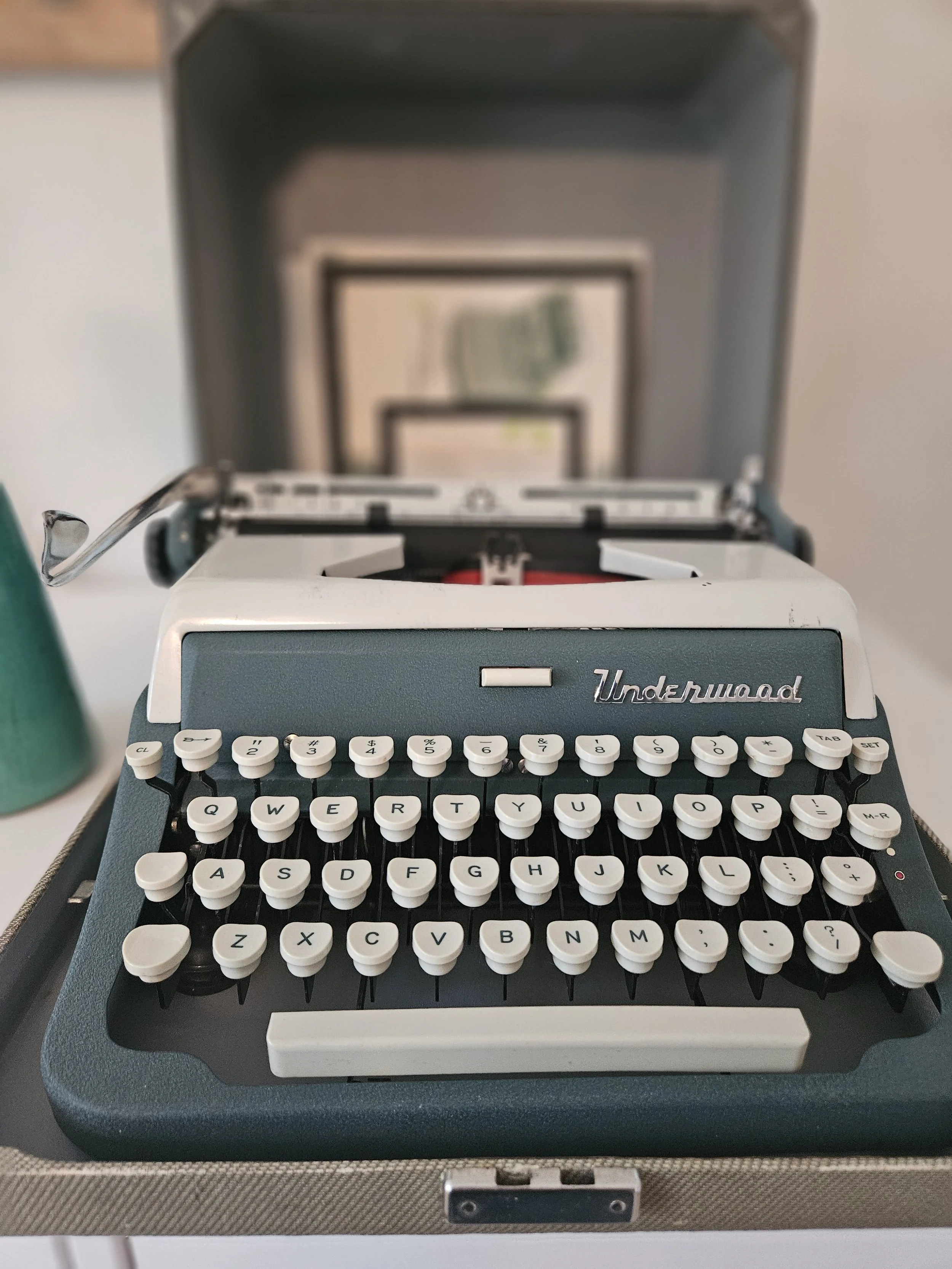
As for paper, you can use any computer paper. Traditionally, typewriter paper was very thin. You'll get a different impression if you use two sheets, one as a 'backing sheet'. Or you'll get a nice feel for letters if you use cotton resume-type paper. Pretty much any paper that the rollers will hold onto will work. Card stock will even work in some machines, as some writers used those literally as note cards and typed them out.
You'll see a video tutorial next to this.
Often there is no '1' key, use the lowercase L. And if there is no '!', use the ', and then back up and put a period under it.
HERE is the manual for this machine.
I sell ribbons here. It can take black or red and black.
Here is the handmade paper that your note came on and the envelope it came in. (In case you decide to enrich the world with your typewritten musings).
A typewriter pad can quiet this beauty some. This is the finest one in the world, in my humble opinion.
Please let me know if you have questions.
Enjoy the writing!
PS. I offer a trade-in policy, in case you ever want to upgrade or switch, you can trade your machine in for the value you paid toward anything else.